
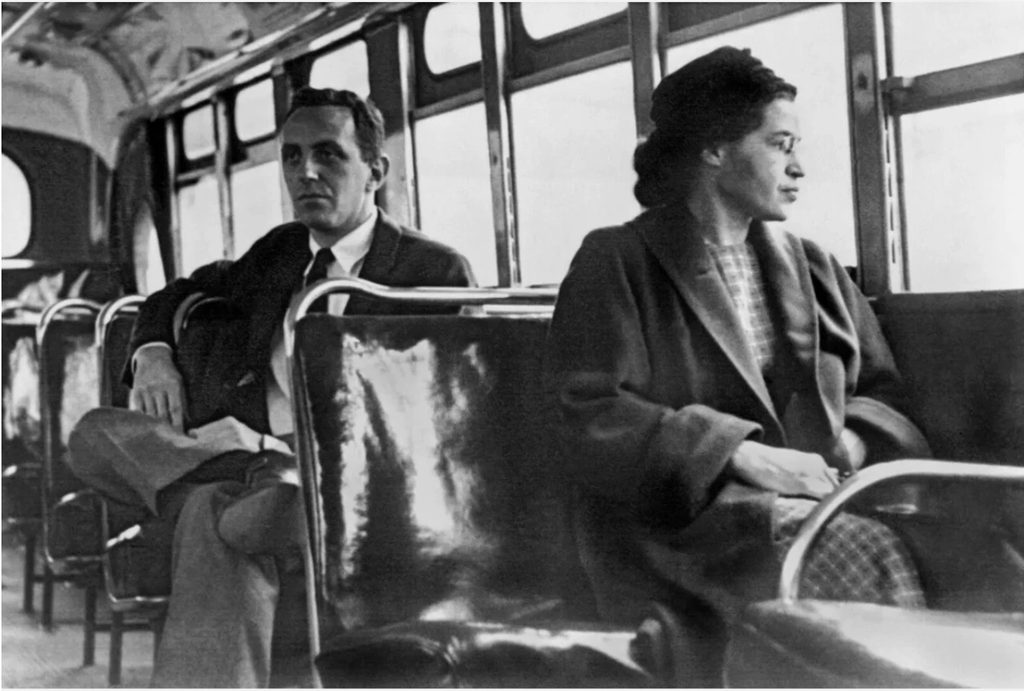
“People always say that I didn’t give up my seat because I was tired, but that isn’t true. I was not tired physically, or no more tired than I usually was at the end of a working day. I was not old, although some people have an image of me as being old then. I was forty-two. No, the only tired I was, was tired of giving in”.
Rosa Parks is best known for her courage to sit at the front of a bus designated for white people only, and her refusal to move to the back. The story goes that she was an ordinary middle-aged black woman who decided she would sit in a white-designated part of a bus in Alabama because she was too tired at the end of her working day and there were no seats available at the back of the bus.
But the reality was very different. Rosa had been a political activist in the civil rights movement in Montgomery for many years before this incident in 1955. She joined the NAACP in 1943 and served as the Montgomery Chapter’s secretary. Her action on that day, December 1[^st] 1955, took place four months after attending a two-week workshop at the Highlander Folk School, an interracial adult education leadership training centre with black and white activists, focused on racial desegregation, non-violent resistance and practical organising. Four days before her arrest, Rosa Parks had heard about the acquittal of Emmett Till’s murderers.
Her act of defiance sparked the Montgomery Bus Boycott that galvanised thousands of people, and led eventually to the March on Washington where Martin Luther King delivered his ‘I Have a Dream’ speech. She is a key public figure in the civil rights movement – known not so much as a leader, as a soft-spoken working class woman that people could relate to.
She was not the first person to refuse to move on a Montgomery bus. Others – including a 15 year old high school girl – had refused and been arrested before. Local leaders were looking for a test case against segregation, and after Parks’s arrest, she was deemed a suitable candidate. On the day of her trial, the Women’s Political Council organised a one-day bus boycott. After she was found guilty, the boycott was extended indefinitely, mobilising thousands of black people in workplaces, churches, community and womens’ organisations. It lasted well over a year before the legal case was won – segregation on buses was deemed unconstitutional – but it was many years before the practice ended.
Rosa protested with her whole body – repeatedly locked up, finger-printed and physically abused but continued to put herself on the front line in the fight for the basic human rights.
Her courage to challenge the system grew from a deep outrage against legally enshrined systemic racism which was also designed to visibly and in a visceral way humiliate and degrade people physically, emotionally and mentally.
From the time the Civil War ended in 1865, thousands of black people were lynched. The Civil Rights Act was eventually passed in 1964, prohibiting racial discrimination in public life across the country – including in accommodation, education and employment. But hard as it is to believe, the practice of lynching continued and was only in 2022 that lynching was explicitly prohibited under federal law in the United States on March 29, 2022, when President Joe Biden signed the Emmett Till Antilynching Act.
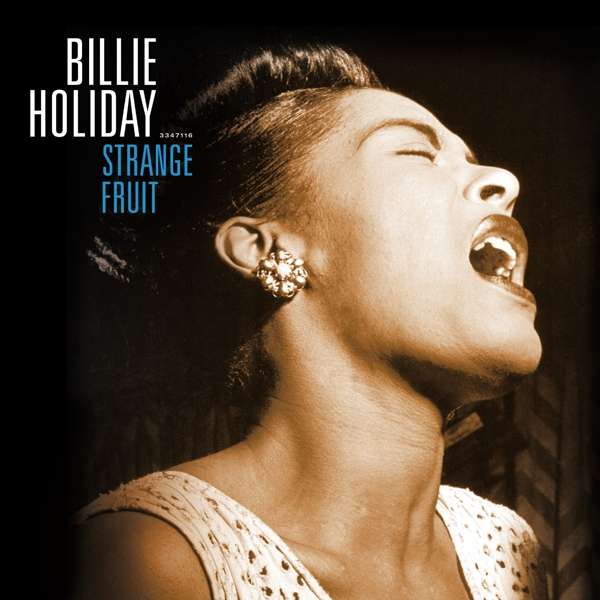
In 1939 Billy Holiday began singing the haunting song ‘Strange Fruit’. The sound of her voice and the lines of the song are unforgettable: “Southern trees bear a strange fruit”, ‘black bodies swinging in the southern breeze’, ’strange fruit hanging from poplar trees’. The lynchings were not carried out in private: victims were abducted, beaten, tortured, mutilated, shot, burned, hanged and left visibly on display. Crowds of white spectators attended many of them – including families and children. Photographs were taken and made into postcards – sold and circulated as souvenirs. The physical signs of racial terror were publicly displayed not only to destroy peoples’ lives. They served as a source of pride for whites to show their power and ability to deny a person their dignity, humanity, privacy and their own impunity from any legal sanction for murder. White people decided whose life had value.
It’s hard to believe that for centuries, people have abused their power and carried out acts of unconscionable acts of cruelty and violence towards other groups of other people simply because of who they are or where they happened to be born. The dehumanisation happens at both ends – those that split off from their own humanity in their acts of violence to others, and those that are subjected to this ‘othering’.
Despite such extraordinary public displays of unimaginable barbarity, there had not been a collective social movement for change until that day, despite the fact that thousands of people were engaged in civil rights actions. There are many examples of people such as the Freedom Riders who were regularly beaten, punched, kicked, arrested, but continued to get on the bus again and again – engaged in non-violent protest.
Among the many forms of non-racial protests were the lunch-counter sit-ins in the early 1960s. They began when four black first-year students from North Carolina sat at the whites-only counter of an F. W. Woolworth store in Greensboro, North Carolina, and politely to be served. When they were refused, they remained until the shop closed. Despite verbal abuse, being repeatedly spat at and doused with mustard and ketchup, they remained calm and disciplined. these actions quickly spread and inspired other students – black and white – across the American south to occupy segregated lunch counters peacefully and refuse to leave when denied service. In Greensboro, the campaign lasted about six months, from February until 25 July 1960, and eventually Woolworth desegregated its counter. The Civil Rights Act was eventually passed in 1964, prohibiting racial discrimination in public life across the country – including in accommodation, education and employment.
Rosa Parks’s ‘ordinariness’ was powerful. She enabled people to relate to a woman whose only crime was to be black and to sit in a particular seat on a bus.
What she did that day was not accidental. It was a strategic act of a quiet leader who was in the right place at the right time to do something powerful that was both symbolic and physical. The fight for social justice cannot be successful with words alone or legal challenges. It always demands practical action, the physical act of people showing up physically, mentally, emotionally that come together and work collectively to achieve their vision for lasting change. But we have also learnt that the flames of resistance need to be constantly rekindled – no fight for social justice is ever won definitively or permanently.
Rosa’s story is in the book I’m writing: Embodied Leadership for Social Change: The Octopus Way.